AI Dungeon Alternatives for D&D Worldbuilding: Which Ones Don't Break Immersion?
Do you remember when AI Dungeon amazed us by creating infinite, no-limits stories as fast as you could type? After that though, the shortcomings surfaced: redbox filters stopping "mature" content, NPCs that forgot you existed, and rules that disappeared during battle. The new versions being released throughout 2026 offer a solution by adding richer memories, customizable filtering systems, and D&D 5E built-in mechanics. Some platforms also now allow for controlling multiple players simultaneously, dropping personalized lore books, or inviting other players for real-time play sessions together.
We played around with dice; played with filter systems under duress; and went on quest after quest (think marathon!) to establish an evaluation system for each format based on immersion as well as adherence to the rule structure. Below is all the "stuff" that keeps your story alive, but not your tavern owner.
How we ranked the contenders
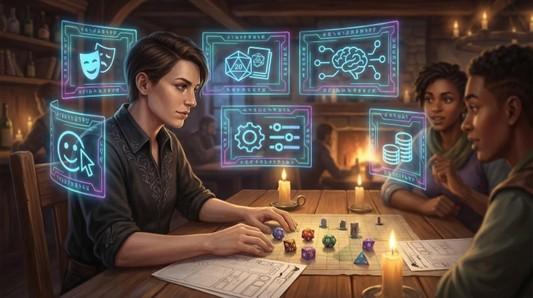
We weren't just selecting names randomly. Each platform had to endure an entire campaign. Once we completed the tavern gossip, wilderness trek, boss fight, and downtime role-play we collected data (track of an instance where someone stumbled, when there was a flash from a filter) from each campaign. We then took the time to compare what we found through our digital notes like experienced dungeon explorers.
To begin, we will evaluate immersion. Does the AI maintain character? Can it recall the bard you hired two sessions ago? Any interruption of the narrative will be marked as a cut point.
Second order criteria to judge fidelity of rule use were hit point tracking, rolling dice and tracking spell slots. If we were required to use a physical manual ledger the total score would decrease.
Third analyzed the long-term memory of the different systems. In addition, we looked at how many tokens or “memory slots” were maintained by each system and whether any previous plot levels were still referenced to any sessions beyond ten.
At last, we looked at ease of customization, usability and cost - That said, seasoned users seek APIs, and newer players appreciate simple user interfaces. We've included budget considerations, certainly they are huge considerations given the six month campaign time frame.
Our 100-point rubric:
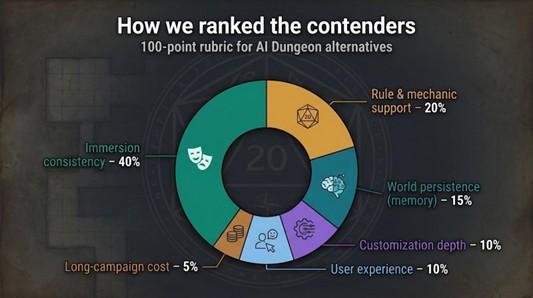
The following percentages represent how much importance players assigned to specific features when giving a game rating.
Consistency in level of immersion: 40 %
Rules and mechanics: 20 %
Persistence of a game world: 15 %
Customization available to users: 10 %
User experience: 10 %
Cost of playing a long term campaign: 5%
The rankings below are based on scores. If two Tools were tied, the Tool that has produced more continuous stories extends that advantage to the new score. Outside of this generality, you can see from each subsequent selection below how truly remarkable each Tool continues to help you generate magic!
1. DreamGen: the unrestricted storyteller
When you turn on the device, one of the first things you will notice is the absence of an audible sound, there are no cursing sounds being emitted. If you have used DreamGen, you know that any dialogue you write will sound exactly like you intended, meaning that, both your dark themes and your humorous moments will outlast the is perceived to be a short period of time to play this form of device. Although we do acknowledge that the device manufacturer, DreamGen States on their web site that their models “do not hold back”, based on our own 12 hour marathon session, we would agree.
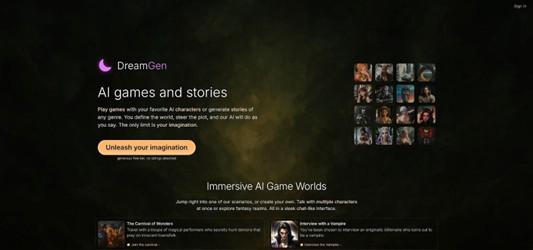
DreamGen AI Dungeon alternative roleplay interface screenshot.
Under the hood, DreamGen offers a roster of open-source models, including a GPT-4-class option on higher tiers. You choose the brain, tweak randomness or repetition sliders, and watch the narrative match your preferred style. Extended context windows and dedicated “Memory” slots mean the blacksmith from session one still honors the discount he promised in session eight. That long-haul memory—coupled with DreamGen’s knack for juggling several player characters in the same scene—is precisely why its own comparison guide, 11 Best AI Dungeon Alternatives for Roleplay and Story Writing, places the platform at the top of a competitive field.
The setup is a simple concept that consists of creating a game world and adding multiple player characters. However, the game has a unique element called Autop-Ilot mode, where you can give the AI control of an NPC to run side quests and let you concentrate on your main quest. For example, we used it to create tavern conversation and the AI never dropped its mask.
The plans available consist of a free tier and a Pro tier with unlimited capabilities. The free tier provides you with complete access to the models, enabling you to assess their capabilities before making any financial commitment to using them.
Storytellers who enjoy complete creative freedom, want to adjust the AI's tone and/or require an open API for use with SillyTavern will find DreamGen's functionality is perfect for their needs. All in all, this is an environment where writers can have total freedom to create without being fenced in.
2. Friends & Fables: the rules-first GM
If you are looking for a D&D 5e fluent AI that comes complete with everything you need, look no further than Friends & Fables! Franz, their resident Game Master, will roll initiative, track spell slots, and narrate the action while you sit there sipping your coffee instead of flipping through rule books.
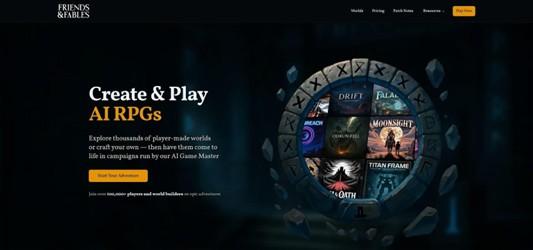
Friends & Fables AI D&D 5e rules-first GM interface screenshot.
This construction will work in battle. We just declared the use of a Reckless Attack against Franz and he provided us with the same benefit mechanics as well as a bloody description of his actions. No separate application required for rolling, no math on paper. Thus, flow is maintained within the game world and the tabletop is kept clear of extraneous items.
The rails are visible when there is no fighting. Sometimes, Franz pushes the story along by pushing an NPC into your tavern scene after just a few lines of conversation. Community testers are noticing the squeeze due to there being only 50 memory slots - the AI has to drop earlier details so they can push newer story elements. If you consider role-playing during downtime as an important part of your immersion, that habit will be taking away from your immersion.
The multiplayer function is excellent. It allows you to play with up to 6 other players over the net simultaneously and watch as Franz resolves your simultaneous chaotic decisions. The four players in our boss battle where we threw our actions at one time did not lose the connection to the game engine.
The price structure is very simple. Players pay $15 per month for two players or $30 per month for six players (on average). For example, a group of six players pays $ an episode compared to a set of printed scenarios which is about $ before printed material.
When you desire to validate that your friends and/or groups follow every rule properly choose Friends & Fables (the game), when you expect a referee will not forget your party's proficiency bonus; and when your group will be playing together through the internet. You will need to remind/ask Franz periodically to "slow down" and allow your players to loiter in the tavern/hall after they finish their drinks.
3. NovelAI: the storyteller’s workbench
There are two kinds of GMs: those who enjoy the crunch of mechanics and those who chase prose that literally jumps off the page to them. If you're in the latter group, NovelAI is a total experience - it's like opening up a leather-bound journal that can respond to you.
At the heart of this entire venture is the Lorebook. You'll create character bios, magic systems, or entire pantheons of lore. The engine will then take all that data and integrate it into each paragraph. For example, your wizard can cast a specific spell from the grimoire you created last week in mid-session and NovelAI will correctly retrieve and execute the exact incantation you wrote down. This allows the world to maintain continuity without having to constantly keep track of things.
The platform is able to work in two different modes. First, the writer can collaborate with the AI on a long and detailed passage using the storytelling mode. Then they can switch to the text adventure mode to return to the more traditional prompt & response style of play with greater quality of writing than was produced by AI Dungeon.
The area of mechanics is where there is an issue, as there are no combat rollers, nor automatic initiative. Dice are also handled elsewhere prior to inputting those results into the fiction. Some players may find this approach freeing while others playing at rule-heavy tables may find it more like homework.
More aspirations cost more money. The mid-tier model ($10 tier) is unlocked and included with the Opus plan ($25 tier); Opus provides the writer with a 70 billion parameter model and also + unlimited photo generation. For writers who desire full sensory detail in their writing, upgrading would be a good investment.
In reality, NovelAI is like a creative worldbuilding tool or a solo GM's reusable resource. Write your worldbuilding references on Tuesday and when you run a game on Friday, your players will be convinced that you spent the last week writing those references because you will have provided them with full descriptions of all aspects of your world.
4. KoboldAI + SillyTavern: the DIY power stack
Operating your AI Dungeon Master is like wiring a secret lair below! There may be sawdust on the floor, but once the light switches are flipped, you control everything. The engine is provided by KoboldAI, the chat front-end is supplied by SillyTavern, and they work together to create a sandbox where you create what large language model dominates the universe.
If you have a newer graphics card, it’s easy to install: clone the repo, choose your model, and open the web user interface. No subscription fees; no limit on how much story you can tell. Want to stay private? Host the server on your own computer. Want to run full throttle? Configure SillyTavern to connect with an external GPT-4 API key, and go for it. All settings (like temperature and penalties for repeating) can be customized to meet your needs.
This level of flexibility increases the level of immersion. Our company took a derivation of Llama-3 and fine-tuned it from our campaign logs so we could watch the AI remember a worthless prophecy from the first chapter like it just happened. A corporate filter could not block out the demon prince's unholy deal because there is no corporate filter.
There is an effort involved in trading. Typically, only small models have difficulty with complex plots when the prompts are not pruned manually. The cost of using a cloud-based model is based on the number of tokens used, so if you do multiple months of epic dialogue, you can quickly add up charges to your bill. Finally, if you want to play with multiple players, you will need to use Discord's screen share feature unless you have already set up a shared chat server.
If you're a tinker who wants complete control of the story and don't mind getting your hands dirty with some command line work, using KoboldAI and SillyTavern is like having your very own wizard tower.
5. Deep Realms: the adaptive world builder
Deep Realms isn’t just a linear campaign; It is a physics sandbox of a narrative. Your set up your continent, place some factions and let the GPT-4-powered platform create evolving storylines that adjust to any natural deviation taken during play. If you have decided to wander from the primary road taken to where the king lives to explore something interesting on the side, the AI will generate a shrine along the way, as well as a couple of characters associated with that shrine who worship at that shrine and a minor artifact that connects back to your main story. You create a coherent world to play in while you’re playing with absolutely no preparation.
Magic has two elements: First, an interactive world that stores location information, NPC relationships and unfinished storylines in a matrix that is invisible to players. Second, an automatic memory layer creates pinned memories that appear naturally during play at a later date. For example, in the prologue, we meet an urhen, we do not remember what we did with him and later are shocked to find him alive three chapters later; a totally different person than he was when we met him, but vital to the climax of the story.
The pricing structure reflects cloud GPU pricing: $8 provides enough for casual players to play once a week, while $25 would meet the needs of a campaign gamer. If you're using GPT-4 heavily, then you'll deplete your credits much quicker than if you switched to 3.5 for less important filler scenes.
Select 'Deep Realms' for when you're seeking a vibrant environment that offers both surprise and respect for established lore. The underlying mechanic is cause-and-effect based, making it a good fit for game tables that place more importance on having a story-first approach than on adhering rigidly to complex rules.
6. Infinity DM: the memory maven
Infinity DM promotes itself through the clear-cut slogan of never forgetting, which we can confirm will hold true when we examined the results from a ten-session adventure. For example, after seeing multiple instances of the website recall a tavern insult made in the very first session, the website was then able to use that memory to fuel the desire for revenge between two players (the group) during the eighth session.
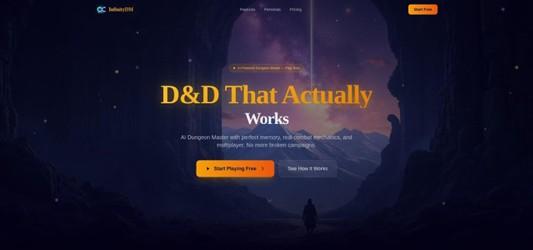
Infinity DM AI Dungeon Master screenshot highlighting memory and combat.
This memory retrieval system is created through a higher level of context cache (Google's Gemini model). By using context against a reduced size token window to extract old conversation, but instead storing important elements (called "beats") into long-term memory until needed, it mimics humanity; enemies retaining grudges, allies remembering good deeds etc., as well as aging alongside you.
The gameplay is very much in the D&D 5e realm, where you roll dice behind-the-scenes and track hit points and conditions. As a true real time multiplayer game, everyone in your party sees the game automatically update at the same time, so you never have to ask “Whose turn is it?” as you wait for the server to refresh.
With its visuals, a crypt is enhanced, making it easier for players to feel absorbed, as an AI-generated image will be able to illustrate the environment for them. Using AI-generated, visual images helps create a strong sense of location by providing an atmosphere and grounding the players to the setting.
The pricing is currently in a state of soft-launch flux, but there are reports from early users of receiving play limits that are per tier and fall at or below $15. If the Infinity DM production team can maintain these costs, then they will be able to undercut nearly all of the other GPT-4 services, while also providing a continuity boost that none of the competing services can match.
When it is most important for story continuity, choose Infinity DM. Infinity DM makes sure that every plot thread is resolved and every sneaky insult is answered.
7. Everweave: the pocket-size adventurer
Either an inspiration can come from riding the subway. Everweave meets that need with their mobile app that contains a lightweight Artificial Intelligence Dungeon Master that you can use even if there's no signal. You will be able to explore a dungeon while airplane mode is active.
It is an upgraded choose-your-own-adventure experience where you are writing the story and the AI responds in a classical high fantasy manner. You type what you want and the AI responds (with no restrictions on content) allowing the story to move forward without interruption. Because the "no-filter" policy exists, there are no limitations placed on bullying heroes or powerful villains taking time to monologue prior to the story continuing.
The trade-off to using an on-device model is its complexity. While on-device models can perform a few main quests without problems, their logic can start to fall apart when attempting to complete five NPCs, solve a riddle and complete an inventory puzzle at once. Some reviewers have said the on-device model is not consistent in its name recognition and it can miscount coins (which may be due to the fact that users are keeping a record of side notes through a journal).
You get great value: a one-time $12 payment allows for unlimited gameplay. You receive updates several times per year, which include new scenarios and minor changes to the models, all at no additional cost.
If you are looking for a unique commute game with no risk, then Everweave is at number one. However, if you are looking for a more complex game that has greater mechanics when compared to this one then go towards the top of this list. But if you want something like Lord of the Rings-themed fun to get away from your work for a few minutes, this app is available in your pocket.
8. AIdventure: the offline old-schooler
When you start up AIdventure with a relatively basic computer, you will be transported to the early, unfettered days of AI Dungeon with the entire model sitting on your local hard drive. No server-based processing, no throttling and no data going to some unknown cloud service! Players who value privacy should take careful note of this.
Since it's equipped exclusively with lightweight versions of the GPT-2 and GPT-Neo AI models, this application has longer response times than some of the larger cloud providers. You'll sit through long minutes waiting for the AI to "consider" what you asked for before finally receiving back a generally bizarre, at times excessively long, piece of text. Although the nostalgia hits hard when done right and although you get to experience the same type of unpredictability as you did in 2019 when you were first introduced to video games through them.
The greatest feature of AIdventure is permanence; you simply pay a one-time fee of $12 through Steam and will never have to pay again. Unplug your Ethernet cord or disable wi-fi, and continue to role-play indefinitely until your battery dies. Modders will have an easier time using newer open-source weights as the community develops (i.e., get better weights).
The people most likely to benefit would be those who experiment, those who produce from rural areas where internet access can be spotty, and those who are storytellers or like owning their equipment outright. If you are patient enough to put up with a slower pace and some nonsensical lines, you'll have a permanent sandbox to play in at no additional cost.
9. AI Game Master: the hybrid showrunner
AI Game Master sits at an intersection of text adventure, tactical battler, and digital art studio. Type any combat move (“I slide between the ogre’s legs and hack at the tendon”) and the engine adjudicates with dice-like logic, then splashes an AI-generated image of your strike across the screen. The visual payoff keeps less text-oriented players engaged.
Usage is measured by a token system that operates behind the scene; a free account regenerates a limited number of actions every three hours, preventing your casual sessions from running out of "action" time too soon. If you are a serious campaigner, you can upgrade to the unlimited Game Master level to ensure that the story continues on without interruption, even during a dragon duel.
Local multiplayer cooperative gaming is enjoyed by many! You can put your laptop on the coffee table, simply move it around to different players and see how the story develops through cooperative play by friends, reacting to each other’s actions! This is a couch RPG, with no need for any miniature figures, that is an excellent activity for gaming night when nobody wants to carry all the game books.
The model has certain limitations as it is PG-13 rated and thus rides the line of the graphic descriptions for materials produced by the model. In the instance where an Art Generator produces an out-of-model Knight and mismatched environmental scenery, hitting refresh usually yields a replaceable piece of artwork to use.
Select AI Game Master if you desire large environments, prefer flexible combat rules, and want to interact socially with your friends rather than strictly use the basic rules. The game turns all your character's crazy actions into postcards and then turns all the postcards into capital to move to the next scene.
10. AI Story Quest: the illustrated page-turner
Imagine a ‘choose-your-path’ storybook that tells you the story and shows you what’s happening as you flip from one page to the next - that's what AI Story Quest is. Each stage of your choice turns into a ‘page’ with narration and a newly created image. Using various mediums (text, audio and visual) helps to encourage kids and visual storytellers who may get lost in long passages of reading to continue.
Free-form actions via branching paths are possible, too - meaning you're not limited to using specific buttons to do your action. If you wish to befriend a goblin as opposed to attacking him, simply type in what you want to do and the results of your action will be depicted in the narrative, including illustrations! The PG-13 content filter keeps the tone of the game light-hearted and swashbuckling rather than dark and heavy; making branching paths an ideal game for families to play.
Credits are needed for turn costs. The $4 Copper plan allows about 150 page flips a month. To avoid interruptions from pop-ups during your marathon, you need a Silver or Gold plan for accessing enough turns without them running out before the end of your marathon!
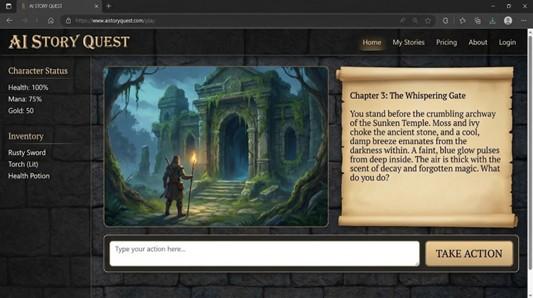
AI Story Quest illustrated AI storybook interface screenshot.
AI Story Quest isn't designed to work with sandbox style games and lengthy rules but excels as a guided narrative roller coaster that connects art, voice and story together. It's suitable for telling stories in the classroom, as bedtime stories or just about any table that prioritizes entertaining visuals over mechanics.
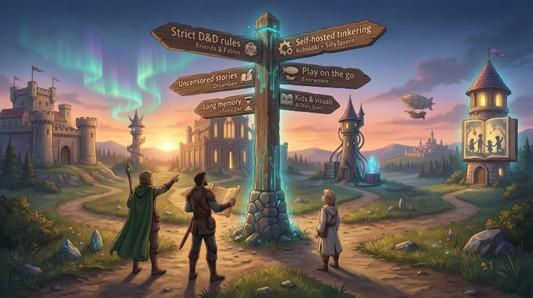
Find your fit fast
10 contenders can feel like choice paralysis. Let’s narrow the field.
Are your homebrewing Dungeons and Dragons sessions needing rigid mechanics? Friends & Fables has what you need.
Are you looking for a creative outlet that allows for unfiltered creative expression? DreamGen has figured that out.
Are you looking for a game that has firm long-term consistency? Infinity DM has got that down to a science.
Are you seeking to create a completely private environment for tinkering with programs? You can make KoboldAI + SillyTavern on a home-built computer.
Do you want to play D&D while travelling? You can take Everweave for offline access to D&D adventures.
Do you want to help younger players learn how to play D&D through visual art? AI Story Quest uses both visual and verbal storytelling to teach D&D.
Use these signposts, start a free trial, and you will know quickly whether the chemistry clicks.
Buyer’s guide & FAQs
A few questions always come up after reading through a list this long. Let’s tackle the big ones.
Does any platform stay completely uncensored?
DreamGen leads the list due to it’s “models with no restrictions” to quote the documentation; our testing has shown no system level blocks. If your noir or grim-darks involve adult themes, use this as your starting point.
Which AI DM truly remembers a long campaign?
Infinity DM lists its tool as having perfect recall, and it even referenced deep session-one events throughout our 10 sessions of use! Users can achieve the same type of consistency using well-tuned models hosted on KoboldAI, though some extra prompt engineering will be necessary.
I need strict D&D rules. What’s the catch with Friends & Fables?
While utilizing Franz for gameplay mechanics of combat, initiative, and inventory will result in a smooth experience, the trade-off will be with pacing. Users have indicated that the AI tends to rush the plot beats due in part to FRANZ's limited memory capacity of 50 memory slots for storing in-game actions, resulting in a lack of opportunity to role-play leisurely. If your gaming group enjoys taking breaks during downtime scenes, you may want to slow things down and create custom instructions for FRANZ to slow things down.
What about price creep?
Different subscription fees exist, often falling into one of two general categories.
Products using large-scale cloud models (i.e., GPT-4, Gemini) generally have a monthly or pay-per-use fee. Therefore, users should budget for $8-$25 per month to maintain uninterrupted access.
Products that are offline or self-hosted transfer the payment obligation from subscription fees to either a hardware purchase or API key purchase. Users will save on future subscription fees but may need to purchase a graphics processing unit (GPU) and/or create a token budget.
Can I import my homebrew lore?
Yes, at various levels. With Lorebook from NovelAI and DreamGen memory slots, you can copy and paste pages of information about your worlds at varying levels. However, Deep Realms goes above and beyond by adding your imported notes into the random side quests. On the other hand, Everweave and AIdventure only take short prompt context (i.e., good for one-off, but not very good for long epics).
Which tool is best for teaching kids or running a classroom demo?
AI Story Quest occupies this area of the market. The illustrated stories are presented with text-to-speech audio and PG-13 content filters, allowing the experience to remain exciting and appropriate regardless of participant preparation.
Narrow Down Your List Using These Answers, Then Give A Free Trial A Go. An AI DM's Personality Will Become Clear Within An Hour Of Actual Playtime.
Conclusion
Once you have created your shortlist based on the above criteria, it’s time to do some hands-on research and see how you feel after playing about 1 hour of real-play session with an AI DM.